
Read Time: 6 minutes
Congratulations! You're about to become parents, and suddenly everyone's asking, "When are you buying a house?" The pressure is real, the stakes feel higher, and you're probably scrolling through listings wondering how other families afford these places.
Take a deep breath. Buying your first home as new or expecting parents doesn't have to be overwhelming. The key is knowing exactly what to tackle first, so you're not spinning your wheels or making decisions you'll regret later.
Let's break this down into five manageable steps that will set you up for success, without the stress.
Step 1: Get Your Financial House in Order First (Before You Even Look at Houses)
Here's what every first-time parent needs to understand: your budget today might not be your budget in six months. Babies change everything about your finances, from daycare costs to one partner potentially staying home.
Calculate Your Real Budget
Don't just use the amount the bank says you can borrow. That number assumes your income and expenses stay exactly the same. Instead:
Start with your current household income, then subtract:
- Estimated childcare costs ($200-2000+ per month depending on your area)
- Increased health insurance premiums
- Baby-related expenses (diapers, formula, clothes, gear)
- Potential income loss if someone reduces work hours
Pro Tip: Use 25% of your take-home pay as your maximum housing payment, not the 28% that lenders often approve. This buffer gives you breathing room for unexpected baby expenses.

Check Your Credit and Get Pre-Approved
Your credit score directly impacts your mortgage rate, which affects your monthly payment for decades. Pull your credit reports from all three bureaus and fix any errors before applying for pre-approval.
Get pre-approved (not just pre-qualified) before you start looking. This means the lender has verified your income, assets, and debts. Sellers take you seriously, and you'll know exactly what you can afford without falling in love with houses outside your budget.
Build Your Down Payment Strategy
You don't need 20% down, despite what your parents might say. Many first-time buyer programs offer 3-5% down options. However, a larger down payment means:
- Lower monthly payments
- No private mortgage insurance (PMI) if you put down 20%
- Stronger offers in competitive markets
If cash is tight: Look into state and local first-time buyer programs, VA loans (if you're military), or USDA loans (for eligible rural areas).
Step 2: Define What "Perfect" Actually Means for Your Family
Perfect doesn't mean mansion with a white picket fence. For new parents, perfect means functional, safe, and within your means. Here's how to get specific about your needs.
Write Down Your Non-Negotiables
Before you start browsing Zillow, sit down with your partner and create two lists:
Must-Haves (Deal-breakers):
- Number of bedrooms
- Safe neighborhood
- Budget limit
- Specific location requirements (commute, family proximity)
Nice-to-Haves (Wish list):
- Updated kitchen
- Fenced yard
- Garage
- Specific architectural style
Keep your must-have list short, ideally 5-7 items maximum. Every additional requirement shrinks your available options and increases your timeline.
Consider Your Timeline
Are you expecting in three months or trying to conceive? Your timeline affects everything:
If baby is coming soon: Focus on move-in ready homes in good school districts. You don't want to be renovating with a newborn.
If you're just starting to try: You have more flexibility to consider fixer-uppers or emerging neighborhoods.
Step 3: Choose Location Based on Your Family's Future
Location affects your daily life more than granite countertops ever will. Think beyond your current needs to where you'll be in 5-10 years.
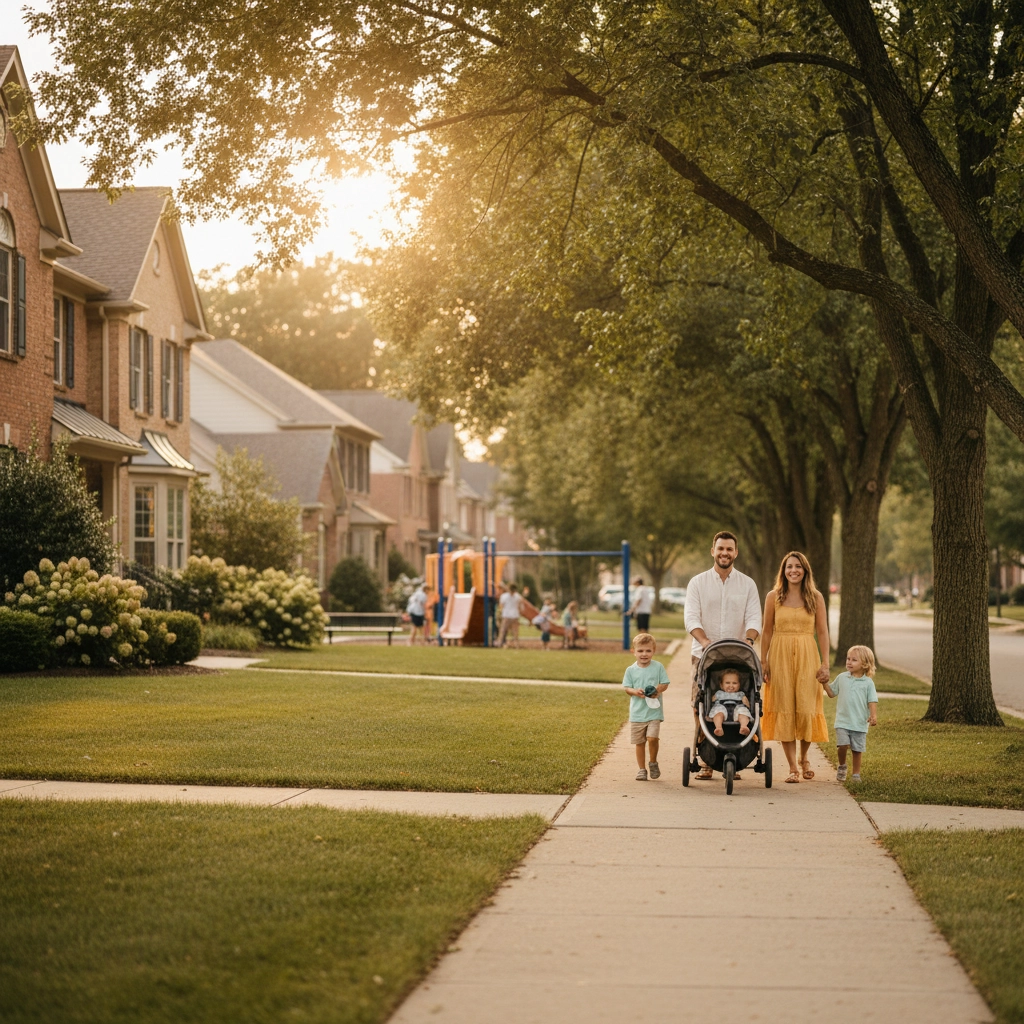
School Districts Matter (Even If Your Baby Isn't Born Yet)
Good school districts typically mean:
- Higher property values and better resale potential
- More family-friendly neighborhoods
- Better maintained public spaces and infrastructure
Research tool: Check GreatSchools.org ratings and look at state test scores, but also drive through neighborhoods during school hours. Do you see kids playing outside? Are sidewalks well-maintained?
Proximity to Support Systems
Consider distance to:
- Grandparents and family who can help with childcare
- Your pediatrician and hospital
- Quality daycare centers
- Your workplace (especially if maternity/paternity leave is limited)
Reality check: A 45-minute commute might seem fine now, but when you're dealing with daycare pickup schedules and sick kids, every extra minute matters.
Neighborhood Safety and Walkability
Look beyond crime statistics to actual livability:
- Can you safely walk with a stroller?
- Are there sidewalks and crosswalks?
- Is there a park within walking distance?
- How's the street lighting?
- Are neighbors friendly and looking out for each other?
Visit at different times: Drive through potential neighborhoods during weekday mornings, after-school hours, and weekend evenings to get a real sense of the community.
Step 4: Prioritize Home Features That Actually Matter
HGTV makes every house seem like it needs marble countertops and barn doors. For families with babies and young kids, functionality beats pretty every time.
Layout Trumps Square Footage
Open floor plans work well for families because:
- You can watch kids while cooking or cleaning
- Easier to baby-proof (fewer hidden corners)
- Better for entertaining family and friends
- Feels more spacious even if actual square footage is smaller
Look for:
- Kitchen that opens to living areas
- Main floor bedroom and bathroom (helpful during those middle-of-the-night baby years)
- Minimal stairs, or at least safe staircases with sturdy railings

Storage and Organization Features
Babies come with an shocking amount of stuff. Look for homes with:
- Built-in storage solutions
- Pantry space (you'll be buying in bulk)
- Coat closets near entrances
- Basement or attic storage
- Garage (if budget allows)
Practical Safety Features
Red flags to avoid:
- Steep stairs without railings
- Windows that open onto roof areas
- Unfenced pools or water features
- Lead paint (homes built before 1978)
- Electrical or plumbing issues that could be dangerous
Nice safety features to look for:
- Level yard spaces
- Fenced backyard
- Updated electrical systems
- Good lighting throughout the house
- Smoke and carbon monoxide detectors
Step 5: Avoid These Common First-Time Parent Mistakes
Learning from others' mistakes saves you time, money, and stress. Here are the big ones to avoid:
Mistake #1: Buying Too Much House Too Soon
Just because you can qualify for a $400K mortgage doesn't mean you should use it all. Babies are expensive, and your housing costs shouldn't make you house-poor.
Better approach: Buy something that works for your current family size with room to grow. You can always move again in 5-7 years when you have better sense of your actual needs and budget.
Mistake #2: Focusing Only on the House, Not the Neighborhood
That perfect house won't feel perfect if you're isolated from family and friends, or if the commute is killing your family time.
Better approach: Choose the neighborhood first, then find the best house you can afford within it.
Mistake #3: Skipping Professional Help to Save Money
Yes, buyer's agents cost money (though sellers typically pay their commission). Yes, home inspections and appraisals cost extra. But these professionals can save you from expensive mistakes.
Investment worth making: A good buyer's agent who understands family needs can show you homes you'd never find on your own and help you negotiate better deals.
Mistake #4: Rushing the Decision
Pregnancy creates artificial urgency, but buying the wrong house is more stressful than renting a bit longer.
Better approach: If your current living situation works, don't rush. Wait for a house that truly meets your needs rather than settling for the first acceptable option.
Ready to Start Your Search?
Here's your action plan for the next two weeks:
Week 1:
- Pull credit reports and check scores
- Calculate realistic budget including baby expenses
- Research 3-5 neighborhoods that interest you
- Drive through potential areas at different times
Week 2:
- Meet with lenders to get pre-approved
- Connect with a buyer's agent who understands family needs
- Create your must-have vs. nice-to-have lists
- Start browsing homes online in your target areas
Remember: The perfect home for your family is the one that fits your actual budget, meets your real needs, and is located where you want to raise your children. It doesn't have to be perfect for everyone else.
Let's Find Your Family's Perfect Home
Every family's situation is unique, and cookie-cutter advice only goes so far. The neighborhoods that work best for families, the financing options available to you, and the current market conditions in your area all affect your home buying strategy.
I've helped dozens of first-time parents navigate this process, from figuring out realistic budgets to finding homes in family-friendly neighborhoods that offer great long-term value. The key is having someone who understands both the real estate market and what actually matters when you're raising kids.
Ready to stop feeling overwhelmed and start making progress? Let's talk about your specific situation and create a plan that gets you into the right home without the stress.
Contact Sean at The Dennedy Home Group to discuss your family's home buying strategy. We'll review your budget, talk about neighborhoods that make sense for your lifestyle, and help you understand what's actually available in today's market.
No pressure, just practical guidance from someone who gets it.